Is a construction site still insured if work stops?
Not safely. Standard CAR wordings carry a general exclusion for cessation of work, whether total or partial, and it applies to the whole policy.
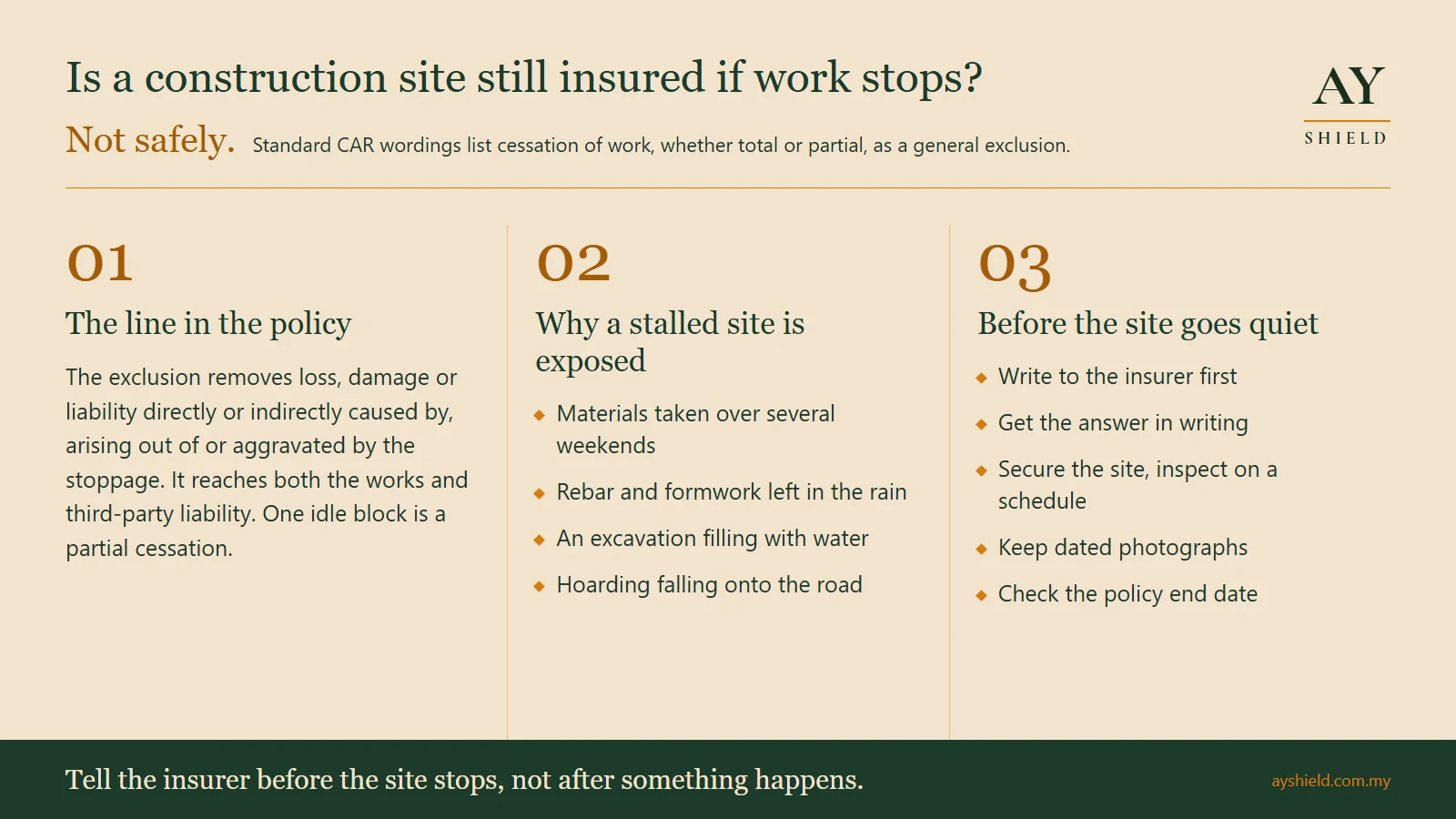
Not safely. Standard Malaysian Contractor All Risks (CAR) wordings list "cessation of work whether total or partial" among the general exclusions. Those exclusions remove loss, damage or liability directly or indirectly caused by, arising out of or aggravated by the listed causes, and they sit above both Section I (the works) and Section II (third-party liability). A policy can still be in force on paper while the stoppage itself becomes the reason a claim fails. If a site is going to stop, the insurer needs to hear about it before it happens, and the continuation of cover needs to be confirmed in writing.
Where the line sits in the policy
A CAR policy opens with a short list of general exclusions that apply to every section: war and civil commotion, nuclear risks, wilful acts of the insured, and cessation of work. The same four-word line, "cessation of work whether total or partial," appears across the standard CAR wordings used in Malaysia. It is not buried in a schedule or an endorsement. It is in the opening pages, next to war.
"The Insurers will not indemnify the Insured in respect of loss, damage or liability directly or indirectly caused by or arising out of or aggravated by ... cessation of work whether total or partial."
Two parts of that sentence do most of the work. "Directly or indirectly" and "aggravated by" mean the stoppage does not have to be the only cause of the loss. And "whether total or partial" means a site does not have to be fully abandoned. One block left untouched while the rest carries on is still a partial cessation.
Why a stalled site is the exposed one
A working site has people on it every day. Materials get used, stacks get checked, water gets pumped out, temporary works get inspected. When work stops, all of that stops with it. The losses that follow are the ordinary ones: materials taken over several weekends, exposed rebar and formwork left in the rain, an excavation that fills with water, hoarding that falls onto the road because nobody was there to see it lean.
Each of those would normally be a CAR claim. On a stalled site, the insurer can point to the exclusion and argue the loss arose out of, or was made worse by, the fact that work had stopped. Because the general exclusions also cover liability, the same argument can reach a third-party claim, such as a passer-by hurt by that falling hoarding.
The condition that tells you what to do
The general conditions of a standard CAR wording require the insured to notify the insurer immediately and in writing of any material change in the risk, and to take whatever additional precautions the circumstances require. They also say that no material alteration increasing the risk may be made unless the insurer confirms in writing that the insurance continues. A site going quiet for weeks is a change in the risk, and this is the condition to act on.
The practical order is: tell the insurer before the stoppage, not after something happens. Ask them to confirm in writing whether cover continues during the suspension, and on what terms. Expect them to ask what you will do to keep the site secure. Keep their reply with the policy.
Before the site goes quiet
- Write to the insurer first. State the date work stops, whether it is the whole site or part of it, and how long you expect it to last.
- Get the answer in writing. A phone call that "it should be fine" is not the written confirmation the condition asks for.
- Secure what is on site. Lock up or remove loose materials, check hoarding and temporary works, and arrange someone to look at the site on a fixed schedule.
- Keep a dated record. Photographs of the site on the last working day, and on each inspection after that, show what condition it was in and when.
- Check the end date. A stoppage pushes completion back, but the policy still expires on the date in the schedule. Extensions need the insurer's agreement.
If the stoppage is part of a wider delay, the delay cost itself is a separate question. CAR excludes consequential loss, including penalties and losses due to delay. See whether CAR covers LAD when a site accident delays the project.
Frequently asked
Is a construction site still insured if work stops?
Not safely. Standard Malaysian CAR wordings list cessation of work, whether total or partial, as a general exclusion. It removes loss, damage or liability directly or indirectly caused by, arising out of or aggravated by the stoppage, and it applies to both the works and third-party liability sections. Notify the insurer before work stops and get written confirmation of whether and how cover continues.
Does the cessation of work exclusion apply if only part of the site stops?
It can. The wording says cessation of work whether total or partial, so a site does not have to be fully abandoned for the exclusion to be raised. One block left idle while the rest of the project continues is still a partial cessation.
What should a contractor do before suspending work on site?
Notify the insurer in writing before the stoppage, stating when it starts, which parts of the site are affected and the expected length. The general conditions require immediate written notice of any material change in the risk, and say the insurance continues after a risk-increasing change only if the insurer confirms it in writing. Secure the site, keep dated photographs, and check the policy expiry date.
Does the exclusion affect third-party claims during a stoppage?
The general exclusions cover loss, damage or liability, so they sit above Section II third-party liability as well as Section I material damage. An injury or property damage claim arising out of a stalled site can be met with the same exclusion.
A CAR policy does not simply keep running while a site sits idle. Cessation of work, total or partial, is a general exclusion that reaches both the works and third-party liability. Tell the insurer before the site stops, get the continuation of cover in writing, and keep the site secured and recorded while it is quiet.
Clause references are to the standard Contractor All Risks wordings in use in Malaysia. Your own policy schedule and endorsements can differ, and the wording that governs your claim is the one attached to your policy. This page is general information, not advice on a specific claim.
AY Shield is a licensed insurance advisor based in Penang, Malaysia, serving contractors across Penang Island and Seberang Perai. We specialise in Contractor All Risks (CAR), WIBA and Public Liability cover for CIDB G4–G6 building and civil contractors. Principal Advisor Au-Yang Liang-Hin has over 30 years of commercial insurance experience.
Published 29 September 2026 · Bayan Lepas, Penang