Installing generators or machinery — do you need CAR or EAR insurance?
If the job is mainly supplying, installing and testing equipment, the policy built for it is Erection All Risks. The difference sits in three lines of the wording — and one of them is the testing stage.
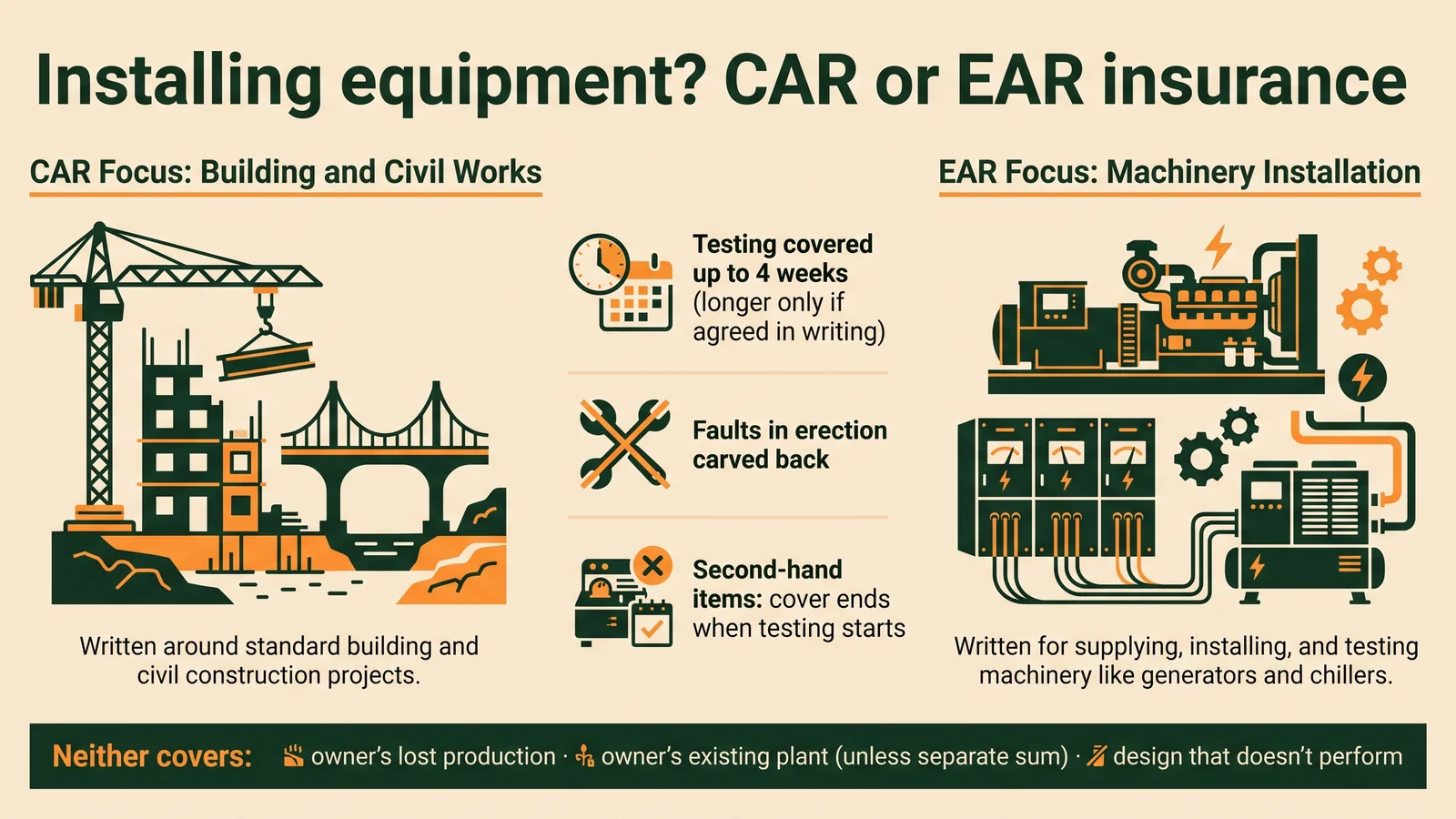
If the work is mostly equipment, you want EAR. Contractor All Risks (CAR) is written around building and civil works. Erection All Risks (EAR) is written around supplying, installing and testing machinery — generator sets, switchgear, chillers, production lines. The two policies share the same skeleton: an all-risks Section I for physical loss or damage, and a Section II for third-party liability. They part ways in three places in the wording: when cover ends around testing, how faults in the installation itself are treated, and what happens to second-hand equipment.
The same skeleton
Both Section I wordings pay for "unforeseen and sudden physical loss or damage from any cause, other than those specifically excluded." Both Section II wordings cover your legal liability for accidental injury to third parties and damage to their property, occurring in direct connection with the erection, construction or testing of the insured items. Fire, storm, theft, a dropped load during lifting — on the face of it, either policy responds. So the question is not which one is "more complete". It is which one was written for the way your job actually runs.
Difference 1: testing and commissioning
For equipment, the most dangerous weeks are usually not the lifting and fixing — they are the first time the system runs under load. EAR builds that window into its period of cover. The insurer's liability runs until taking over, or until the first test operation or test loading is completed, whichever is earlier, "but not beyond four weeks (unless otherwise agreed in writing) from the date of commencement of the test."
"…until immediately after taking over or after the first test operation or test loading is completed whatever is the earlier, but not beyond four weeks (unless otherwise agreed in writing) from the date of commencement of the test."
The CAR period of cover says nothing about test runs. It ends for any part of the works that is taken over or put into service. If your commissioning plan runs longer than four weeks — load-bank tests, synchronisation, integrated system testing — that is exactly the "otherwise agreed in writing" your advisor should put on the schedule before the policy starts, not after something trips.
Difference 2: faults in the installation itself
Both policies exclude faulty design. CAR excludes "loss or damage due to faulty design, drawings and/or specifications," and the cost of rectifying defective material or workmanship (though not damage those defects then cause to correctly built parts). The EAR exclusion reads differently. It excludes loss or damage due to "faulty design, defective material or casting, bad workmanship other than faults in erection."
Those four words carve the installation work back in. For an equipment job, a mistake during erection — a misaligned coupling, a wrong connection, a bad fixing — is one of the ways equipment actually gets damaged. How that carve-back applies to a real loss still turns on the facts and the adjuster's findings, but it is the clause that makes EAR fit installation work in a way CAR's wording was not built to.
Difference 3: second-hand equipment
EAR treats used machinery differently: "In the case of second-hand items, the insurance hereunder shall, however, cease immediately on the commencement of the test." If you are relocating a used generator or re-installing refurbished equipment, the testing stage — the riskiest part — is not covered at all under the standard wording. Tell your advisor at the quotation stage which items are not new.
What neither policy does
Three gaps are the same in CAR and EAR, and they matter most when the equipment goes into a plant that is already running.
- The owner's lost production. Section I excludes "consequential loss of any kind or description whatsoever including penalties, losses due to delay, lack of performance, loss of contract." If a shutdown for your tie-in stops the owner's line, the policy pays for physical damage — not the output they lost.
- The owner's existing plant — unless you insure it separately. Section II excludes property belonging to the principal or held in the contractor's care, custody or control. Under EAR, loss of or damage to surrounding property is covered only "provided that a separate sum therefor has been entered in the Schedule." In a factory full of expensive machinery, that separate sum is a number to set deliberately, not leave to a default.
- A design that doesn't perform. Faulty design is excluded, and so is "lack of performance." If your contract is design-and-build or turnkey and makes you responsible for load calculations or system design, that is a separate conversation with your advisor — CAR and EAR are not written to pay for it.
Sum insured: the full installed value
The EAR wording requires the sum insured to be "not less than the full value of each item at the completion of the erection inclusive of freight, customs duties, dues, erection cost." If it is lower, any claim is reduced in the same proportion — and "every object and cost item is subject to this condition separately." Using the equipment invoice alone, without freight, duties and installation, is an easy way to end up underinsured without knowing it.
When the contract says CAR but the job is equipment
Employers often use a standard insurance clause that names "Contractor's All Risks" whatever the work is. We saw this on a recent generator installation inside an operating plant: the contract asked for CAR, while the scope was almost entirely supply, installation, testing and commissioning. The practical fix is to ask the employer, before signing, to accept EAR or to write the clause as "CAR/EAR" — in writing. For the wider problem of a policy that doesn't line up with the contract, see tender awarded, but the policy doesn't match the contract.
Frequently asked
Should a contractor installing machinery buy CAR or EAR insurance?
If the work is mainly supplying, installing and testing machinery or equipment, Erection All Risks (EAR) is the policy written for it; Contractor All Risks (CAR) is written around building and civil works. Both have an all-risks Section I for physical loss or damage and a Section II for third-party liability. They differ in three places in the standard Malaysian wordings: EAR's period of cover runs through the first test operation, its design exclusion carves back faults in erection, and it ends cover for second-hand items as soon as testing starts.
Does EAR insurance cover testing and commissioning?
Yes, within a limit. The standard EAR period of cover runs until taking over or until the first test operation or test loading is completed, whichever is earlier, but not beyond four weeks from the start of the test unless the insurer agrees otherwise in writing. If commissioning will take longer than four weeks, the extension needs to be agreed and recorded before the policy starts.
Is second-hand equipment covered under EAR during testing?
No. Under the standard EAR wording, for second-hand items the insurance ceases immediately on the commencement of the test. Relocated or refurbished equipment is covered during erection, but not during the testing stage, so the insurer should be told at quotation which items are not new.
Does CAR or EAR cover the owner's lost production if a shutdown goes wrong?
No. Both CAR and EAR exclude consequential loss of any kind, including penalties, losses due to delay, lack of performance and loss of contract. They pay for physical loss or damage and third-party liability, not the output an owner loses while their plant is down. Damage to the owner's own existing plant is also only covered under EAR if a separate sum for surrounding property is entered in the schedule.
For a job that is mostly supplying, installing and testing equipment, Erection All Risks is the policy written for it: its period of cover runs through the first test operation (up to four weeks unless extended in writing), and its design exclusion carves back faults in erection. Check three things before it starts — the testing period on the schedule, a separate sum for the owner's surrounding property, and a sum insured that includes freight, duties and installation.
Clause references are to the standard Contractor All Risks and Erection All Risks wordings in use in Malaysia. Your own policy schedule and endorsements can differ — the wording that governs your claim is the one attached to your policy. This page is general information, not advice on a specific project.
AY Shield is a licensed insurance advisor based in Penang, Malaysia, serving contractors across Penang Island and Seberang Perai. We specialise in Contractor All Risks (CAR), WIBA and Public Liability cover for CIDB G4–G6 building and civil contractors. Principal Advisor Au-Yang Liang-Hin has over 30 years of commercial insurance experience.
Published 25 September 2026 · Bayan Lepas, Penang